Keep your thirst quenched without the baggage

Posted By Kent Klewein / May, 17, 2012 / 2 comments

Feeling the love from my Katadyn water bottle during a long hike-in out west. Photo By: Louis Cahill

It’s late spring and everyday we’re moving one step closer to summer. Air temperatures are climbing into the 70s and 80s on most days and will soon be even higher. These conditions make it extremely important that anglers are staying properly hydrated while they’re on the water fly fishing. I really enjoy hiking into remote locations to fly fish for trout. The only problem with me doing this is I’m constantly fighting to quench my thirst and stay hydrated. I used to utilize packs with internal bladders for storing my drinking liquids, but there were quite a few disadvantages that came along with using them. First, when filled to full capacity, they become quite heavy and take a tole on your body lugging them around all day. Secondly, if you’re using them during the warm seasons and you’re doing some aggressive hiking and fishing, eventually that cold liquid you filled the bladder with in the morning will eventually warm up and end up tasting like bath water. Thirdly, internal bladder systems require maintenance and cleaning to keep them from building up bacteria and mold. Five years ago, I decided to ditch the internal bladder systems in exchange for a light weight water filtration bottle, and I’ve never looked back. Doing so I eliminated the three negatives I mentioned above with using internal water bladders, and I no longer have to ration my water intake during the day. This product will keep you fresh during your time on the water and you’ll have far less fatigue when you return home.

Katadyn Water Filtration Bottles


There are several companies in the outdoor industry that manufacture water filtration bottles. Before I bought mine I took the time to ask several of my fly fishing buddies who spend a lot of time traveling and hiking to fly fish. Almost every fishing buddy of mine recommended that I go with the company Katadyn. Pricing and models range from $44.95-$79.50 and can safely filter 100 liters of water before the filter needs to be changed.

Keep it Reel,

Kent Klewein
Gink & Gasoline
www.ginkandgasoline.com
hookups@ginkandgasoline.com
 
Sign Up For Our Weekly Newsletter!
 

My Favorite Bonefish Reel

Posted By Louis Cahill / May, 16, 2012 / 0 comments

Bigger is Better Photo by Louis Cahill

Best of all it only cost $285

I remember standing on the beach at Andros South watching my buddy Bruce Chard teaching his annual bonefish school. Bruce was illustrating for a first timer what he should expect when he encountered a bonefish. He held the line and let the student feel how hard he should strip set, then he took off running down the beach a fast as he could. The student did a good job of clearing the line and getting Bruce on the reel but I’ll never forget the look on his face when Bruce turned and ran straight back toward him. He stood slack jawed, line piled up at his feet while Bruce and I laughed.

That’s exactly what a bonefish will do to you. They can swim thirty miles per hour and at some point, as they go ballistic and criss cross the flat they’ll head straight for you. You had better be ready to pick up some line in a hurry. The first time it happened to me I struggled. My reel wouldn’t pick up the line and I resorted to stripping it in by hand. My guide told me to, “get rid of that trout reel.” Of course, it wasn’t a trout reel but it clearly wasn’t a bonefish reel either.

The next time I went bonefishing I had to be better prepared. I knew I needed a reel with a really large arbor but didn’t relish the idea of dropping the cash on another new bonefish reel. Fortunately there was another solution. I had a Nautilus NV Ten-Eleven, a great salt water reel. I bought the Nautilus G-8 spool for it. The G stands for Giga. This spool turned my Ten-Eleven into a super large arbor eight.

It’s a brilliant product. The spool is fast and easy to change and really gives the reel some power to pick up line with it’s 4.25″ arbor. It’s highly vented so the line dries quickly, which cuts way down on the chance that you spool will corrode from holding wet line. It’s light (7.2 oz) and holds 225 yards of 30 lb backing with an eight weight line. It lets me take advantage of the awesome Nautilus drag and cuts down on line memory so less tangling on the deck. Best of all it only cost $285. Of course you can buy the reel with the G-8 spool for $670 and it’s worth it. It’s quickly become my favorite reel and I’ve had no trouble out of those bonefish since.

Don't forget to soak you reel photo by Louis Cahill

 
Louis Cahill
Gink & Gasoline
www.ginkandgasoline.com
hookups@ginkandgasoline.com
 
Sign Up For Our Weekly Newsletter!
 

Articulated Nymphs, All Hype or the Real Deal?

Posted By Kent Klewein / May, 15, 2012 / 7 comments

Articulated Nymphs, All Hype or the Real Deal? Photos By: Louis Cahill

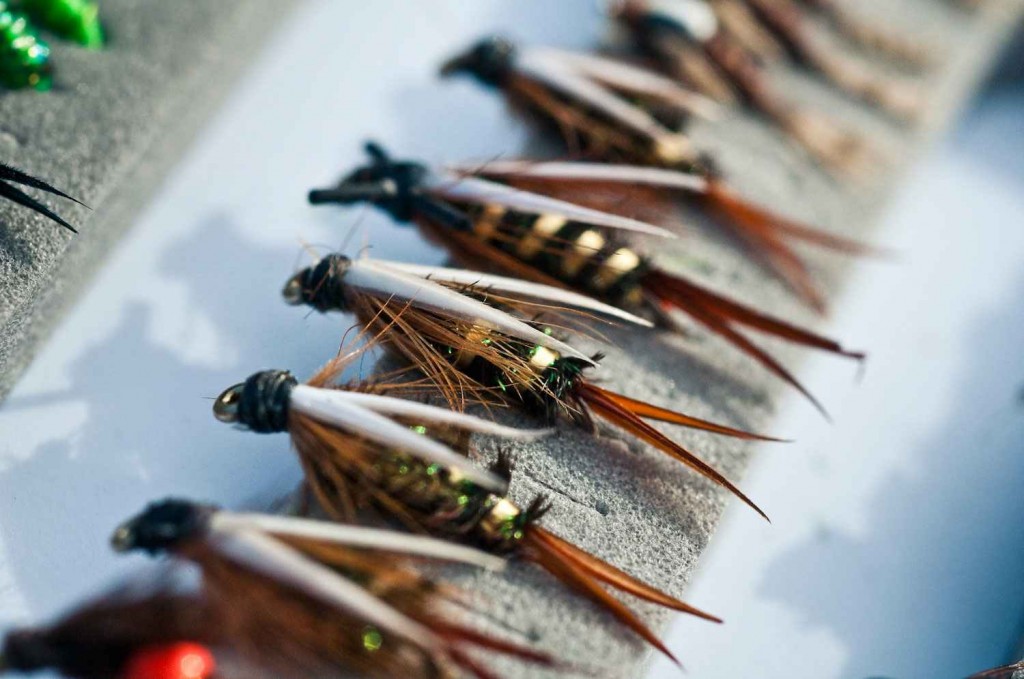
If you pull any serious streamer fisherman aside and ask them to name their favorite streamer pattern, chances are the fly pattern will be articulated. Ask the same question instead to a serious nymph fisherman, and most will answer with names of nymphs that aren’t articulated. I agree you don’t have to fish articulated nymph patterns to catch trout, but I do find it a little odd that we aren’t seeing more of them in the spot light today. As far as I can tell, the concept has been around almost as long as articulated streamers have. The last couple of years I’ve started to incorporate articulation into my fly tying for many of my nymph patterns. Just about all of them have done very well for me on the water. In some cases, my articulated versions have caught trout 3 to 1 over the traditional non-articulated versions. You can’t tie all nymphs articulated because many fly patterns and species of aquatic micro-invertabrates are far too small. However, with some practice, most fly tiers will find it’s pretty easy to tie articulated nymph patterns as small as a standard size 16 nymph hook.


For the most of my fly fishing career, I thought the majority of aquatic nymphs were poor swimmers. I pictured them in my head spending most of their time drifting helplessly in the current incapable of generating enough propulsion to maneuver around. The fact is, most nymphs, particularly mayflies, are very good swimmers. Take a couple minutes to view these video links of aquatic insect larva swimming in the water, and it will blow your mind. After viewing these videos I think you’ll begin to understand how valuable articulated nymphs can be at imitating the movements of swimming nymphs.

Leptophlebia Mayfly Nymph

Isonychia Mayfly Nymph

Brown Drake Nymph

Keep it Reel,

Kent Klewein
Gink & Gasoline
www.ginkandgasoline.com
hookups@ginkandgasoline.com
 
Sign Up For Our Weekly Newsletter!
 

The past decade and a half they have become quite the popular choice for their ability to add increased  swimming action they provide when retrieved. The last couple of years I’ve begun tying and fishing more articulated nymphs.

Not Just Anybody’s Saint Vrain

Posted By Louis Cahill / May, 14, 2012 / 26 comments

John Gierach Lands A Brown Trout Photo by Louis Cahill

“If you climb into the cab of that pickup with John you’ll find that where you wind up can, only in the most existential terms, be called a fishing trip.”


It’s about seven-thirty on a Saturday morning. It’s mid-September and the chilly Colorado air has coaxed a fair number of lookie-lous, headed up from Denver and Boulder to catch some fall color, into the Stone Cup Cafe on highway thirty-six in Lyons for a cup of hot coffee. A dozen or so of these plains dwellers are queued up like good little office workers waiting their turns when a lanky man in his seventies comes through the door. He is not, at once, remarkable. He’s wearing blue jeans, faded with a hole or two, cinched up with a belt to fit his slim frame. A fleece vest and sun-bleached hat frame an angular face that’s lined like a gazetteer. There is a little white feather tucked into his hat band, like Peter Pan. His white beard seems to pretty much have the run of his face. It’s had just enough grooming to suggest that there’s a woman involved somehow, but she’s learned to pick her battles. His bright blue eyes seem too young for the rest of him. He doesn’t dally. He has the stride of an experienced hiker who sets a pace and covers his allotted miles without complaint, his eye fixed on a distant peak. That peak, at this moment, being the coffee pot.

This fellow may not have raised much attention from the morning crowd when he came through the door, but that quickly changes as he walks promptly past the line, around behind the counter and to the coffee machine where, seemingly unnoticed by the staff, he sets about pouring two cups of coffee. He tucks a couple of bucks in a basket that hangs on the wall by the coffee pot, picks up his two cups and with the same determined stride walks back by the line of dumbstruck tourists. He doesn’t acknowledge them, their galled stares or open mouths. He is completely stoic until he is past the line and makes it to the door. He reaches out his hand and offers me a cup and an impish smile creeps across his face as he says, “I love doing that.” And in that instant, there he is, the man I have come to know through his words long before I laid eyes on him. This is John Gierach.

I met John a year earlier at a fly fishing trade show in Denver. I was at the Whiting Farms booth pouring through a selection of high quality rooster capes when he took up a place next to me and within a few moments began telling me how to kill a chicken with a stick. This would, no doubt, have seemed odd to me had I not known exactly who I was talking to. How could I not recognize this man? I’ve read more of his books than any three authors combined. Of course I knew him and I knew that he had tried his hand at raising chickens at the little house across the street from the Saint Vrain River and that it had been a total disaster and that he had to move when the well became contaminated from the gas station next door and a hundred other personal details that had forced their way into his stories. Had I known all there was to know about raising chickens and been the fellow who had first thought of killing one with a stick and gone on to raise that killing to an art form and had the very act of killing a chicken named after me, I would have still hung on every word. We chatted for a bit and exchanged cards and I expected that to be the end of it.

I discovered John’s writing at the point of one of those great cosmic detours that life takes. I had lost my father to cancer and both of my grandfathers shortly after. I still had a lot to learn from those men when their voices fell silent. I had set a lot of goals as a young man that, once attained, had not provided me with much in the way of happiness. My career as an advertising photographer seemed to be feeding on my sanity. The harder I worked and the more money I made the unhappier I became. My anger rose like a fire alarm ringing in my head and after giving some serious thought to shooting one of my clients, and I don’t mean with a camera, I decided to take some time off to appreciate my freedom. I made time to fish for the first time in years. I picked up a copy of “Trout Bum” and something clicked.

No one knew what a trout bum was in 1986, when the book was published. As far as I know John coined that term. We didn’t realize that, while we were busy with careers or school or raising families, those guys were out there. While we worked and sat in traffic or in front of the television, they were sacrificing comfortable, normal lives and relationships to spend their days, cold and wet, standing in a river and nights sleeping in the bed of a truck.

“When I started fly fishing we were out there looking for a mystical experience, and we found it” John told me. I got that from his writing. That book took me on a journey from which I would never return. It was as if he opened the door of his old pickup and said,”climb in” and took me to a place that I didn’t know existed.

I remember reading, “Trout are among those creatures who are one hell of a lot prettier than they need to be. They can get you wondering about the hidden workings of reality.” That observation is true, but it’s also a hint at what John is really up to. So conversational and understated it may not, at first, seem remarkable but if you climb into the cab of that pickup with John you’ll find that where you wind up can, only in the most existential terms, be called a fishing trip.

Like the prose of Hunter S. Thompson rose above the chaos and delirium to find the truth, John’s words transcended the fishing and tying and sleeping in the truck and found a connection to the workings of reality. For me it was a turning point. Hunter Thompson with a fly rod instead of drugs, I still think of him that way, but I don’t think he’d like it.

I ran across a photo of John, I can’t remember where, on a book jacket or in a magazine. He was standing in a stream, wearing hip boots holding a glass of wine and a cigar I think. The details are fuzzy now but it was an odd little photo. One of those things born of good intention but gone horribly wrong. Someone had obviously thought about it way too much, perhaps more than they had looked at it. I studied the image for a while, trying to square it with the man’s words, trying to picture the witty energetic fellow who had explained chicken killing to me actually doing this. It continued to bother me long after I forgot where I’d seen it. I just kept thinking, he deserves better.

Photo by Louis Cahill

I sat down at my computer to write an email and pulled the business card from my wallet. It read, John Gierach “editor at large.” No email address, no phone number, just a street address. I don’t know why it surprised me. It was charming really, in this age of skepticism and mistrust, this little card seemed to say, “stop by if you’re in the neighborhood.” As a sign of respect and as if to say, “OK, I’ll play along,” I did something I haven’t done in years. I wrote a letter. After a few weeks I received a reply. “Yes, of course I remember you. I’d be happy to sit for a portrait.” I packed a camera, a light and a bamboo fly rod and booked a flight to Colorado.

Arriving at John’s home I am struck by the view. It’s the house at the end of the dirt road, nothing out the back door but the Colorado front range and its endless peaks and valleys and secret streams. “We enjoy it,” john tells me “but we have to keep the cats in at night, mountain lion got the last one.”

Inside I meet Susan, the woman whom I’d imagined choosing her battles. A bright and vivacious woman, innately positive with an active and instant curiosity, who makes conversation like a reporter, which she is. She reminds me a bit of Katharine Hepburn, whom I have always adored. I now feel certain she could whip that beard into shape if she felt the need. John and I excuse ourselves and head down the stairs to his office for the photo shoot.

Remember the story of Aladdin and the magic lamp? Remember the cave of wonder, filled with the treasures of the world? That’s what’s at the bottom of those stairs. A dimly lit basement in a modest mountain home, but filled with the wonders of my childhood.
A hundred bamboo fly rods, most of them old, are stacked on every flat surface and leaning against every wall. The room smells of oil cloth and leather. Beautiful old side-by-side shotguns guard every corner; the nicer ones in racks on the wall next to oil paintings by Bob White. Rows of classic trout reels and larger Spey reels and in the far back corner of the room an old wooden office chair and, I trust, a desk hidden under that mound of hard bound books. This, I assume, is where the magic happens.

There is a door that leads out to a sort of patio space under the deck. It feels right, so I hang a backdrop and set up my light while John gets ready.

When John comes out for his photo he sets down his coffee, takes off his hat and vest, and combs his hair. He addresses the camera and says, “OK.” I make conversation about something while I gather up his hat and vest. “Why don’t you put these on,” I say, offering them to him. When he’s put them back on I offer him his coffee and he takes it. He gives me a quizzical look.

“This is exactly how I walked out here.”

“I know,” I answer. He shrugs and we get on with it. It’s clearly not how he’s used to these things going, but John is comfortable and easy to photograph. We talk for a few minutes and take a few photos. “let’s go fish,” I say. I receive no argument.

“I’d fish anybody’s Saint Vrain.” That remark, made by John’s friend A.K. Best, would end up the title of one of his stories. The Saint Vrain is technically a creek, but the locals all refer to it as a river. It’s John’s home water and I’ve read about it so many times that I feel like I’ve fished it. He had suggested taking me there and I was thrilled. After reading so much about this stream I was getting a first class introduction.

“There’s a little stretch I like,” he tells me. “It’s just off the road but it’s rough as a cob.
Not many folks go down there. We should have it to ourselves.”

“Sounds good to me,” I replied.

Photo by Louis Cahill

We turn off the main road and follow the canyon wall some way above the creek.

“When I moved out here from Michigan,” John says, “I thought there was water everywhere. There isn’t. This state is actually really arid but along the creeks was just the easiest place to build the roads so everywhere you drive there’s water. It played hell with some of the streams but I guess it worked out OK for the fishermen.”

We stop at a nondescript pullout. You can’t even see the river, just a faint trail leading down into the canyon. We rig up our rods and spend the requisite few minutes each studying the other’s. This ritual is fairly unique to boo heads but it’s an important part of the culture. Like a Japanese person will take a moment to study your business card before filing it respectfully away. It’s a sign of respect but also of genuine interest. Like fishermen, every cane rod has a story and some of them are true.

I put on my waders and boots, my fishing pack and the two waist bags that carry my cameras. John dons a pair of hip boots, the ones I’d seen in the photo I suspect, pops a fly box into his shirt pocket and is polite enough not to point out how over-prepared I am. We head down the trail to the river.

“How do you want to do this?” John asks when we reach the water.

“I like to take turns on a stream like this,” I reply. “Why don’t you start and I’ll take a few photos.”

John lifts the fly box from his shirt pocket with two fingers and opens it. He looks around to see what’s in the air or on the water. The box is small, a few dozen flies at best. One side filled with bushy dries, Caddis, Green Drakes, some Adams, a few parachutes and some terrestrials. The other side is nymphs, a healthy selection of Soft Hackles and some beautifully tied Stone Flies, some of them truly huge, standing out bright yellow against the grays and browns of the rest. It dawns on me that I am looking at the home water box. I remember John writing about it in “Trout Bum.” “The single box I try to carry on expeditions to local, well-known waters in an ongoing act of ascetic bravado,” he had called it.

In that story John spends the coldest night in recorded Colorado history tying flies for the coming season, drinking beer and talking to the dog. He describes the patterns in detail, recalls special fish that each has caught and plans fishing trips where they will be used. With both the phone and truck battery dead he feeds the wood stove and takes us along as he falls deeper into the meditation of tying.

John’s flies are very traditional in design, but like any good fisherman he has added his own twists, subtle but significant modifications that make them his own. The flies are sparse for the most part and the proportions are wonderfully elegant, the sign of a truly great tyer. Watching John select a fly, it strikes me that he holds the fly box like an open book. A posture, no doubt such a part of his muscle memory that he is as unaware of it as you might be of a blink. It’s appropriate, like so much of this man’s life, the fly box is an open book in which you can read the story of his life.

He makes no attempt to hide it from me. John is nothing if not shockingly open and honest, sometimes to the point of being confrontational. There are Green Drakes hatching so he ties on a good imitation and then selects a dropper, a curious variation of a Hare’s Ear Soft Hackle. He takes a second one from the box and gives it to me. “These work well down here,” he tells me. In the book he had called this fly ugly. It’s anything but. I can not help but picture him next to that wood stove on a cold winter night tying up a dozen of these. Carefully crafting each one from hare’s mask, hen hackle and electrical wire. I picture that moment where he sits, his dog at his side, tying this fly for me. It’s a connection too powerful for me to ignore. Too precious to leave on a rock or tree branch at the bottom of a stream. I take the fly and tuck it carefully in my box.

“Will you get your feelings hurt if I don’t fish this.” I ask. “I’d like to keep it.”

He hands me another.

Photo by Louis Cahill

I take a few shots of John fishing and then get preoccupied with taking close-ups of the Drakes drying their new wings in the sun. The day has turned warm and the sun that finds its way into the canyon is welcome. The Saint Vrain reminds me of Noontootla Creek where I learned much of what I know about trout. It’s rushing pocket water, cold, loud and full of life of all kinds. The kind of stream where you high stick dries and get splashy takes right at your feet. This kind of fishing brings out the kid in me and when I get the chance to do it, I wonder why I do anything else. It doesn’t take long for John to hook a fish. A beautiful brown about ten inches, exactly what you would expect here.
I’m in a good spot and I take a photo as he lands the fish. It’s one of those rare occasions when you are lucky enough to be aware of the context of the moment. I am photographing John Gierach landing a brown trout on the Saint Vrain with a bamboo rod, quite possibly the most iconic image in fly fishing. It remains one of my favorite photos.

“I wasn’t sure about you at first. I mean, how you’d want to go about this, if you’d want to stage something or just go at it,” John comments while releasing the fish. He is clearly pleased with the answer.

I’m up and John’s fly works. I catch a spunky little brown just dapping a pocket ten feet away. I tell John that my brother, a bass fisherman as dedicated to that endeavor as I am to mine, asked me, “do you count the ones you catch like that?” “Tell him you don’t count any of them!” John replies. I mention how beautiful the trout in this river are and explain to John how my fascination with the fish is really what has kept me fishing all these years. I use a phrase I have used a hundred times before: “They’re like swimming jewelry.”

“That’s beautiful,” he says, “I’m going to use that.”

“Be my guest,” I replied.

“I don’t need permission,” he fires back and shows me that smile I’d seen earlier in the coffee shop. I feel certain I’m not the first fisherman to hear this.

John would quote me in the next issue of Fly Rod and Reel. I was clearly wrong about the desk, this is where the magic happens.

The Saint Vrain has made good on its promises. There are mayflies in the air and fish in every pocket and as John had predicted, not a soul but us. Fly fishing is no easy endeavor. That is, of course what draws most of us to it. Fly fishers are a masochistic lot who, for the most part, enjoy doing things in the hardest way possible. With guilty pleasure, we relish days like this. Days when the fishing is easy. Days when you don’t work for your fish, you play with them. We don’t go home and tell our family’s or call and brag to our friends, but inside, we love it.

John and I leapfrog up stream, taking turns fishing, telling stories and laughing, then John finds a tangled wad of monofilament in some brush along the bank. His reaction is
visceral. He rips it out of the bushes. his face is drawn and angry. His body has become
suddenly stiff, every movement forced as if he were trying not to punch someone who
really deserved it,

“That really pisses me off,” he mutters. Shaking the wad of mono at me he continues “Never leave mono on the river,” his voice is louder and angry now, like he’s scolding me. “Not even a little piece,” he goes on. “Well, I’m not talking about the tag end off your fly, you know what I mean.”

My grandfather had that kind of temper and for a moment I feel like a kid who lost my grandad’s favorite fishing rod. It must have shown on my face. He’s suddenly aware that he’s scolding me for someone else’s mistake and is clearly a little embarrassed but still angry.

“Sorry,” he says, ” I found a little squirrel dead down here once, all tangled in a bunch of mono.”

It takes a minute for him to settle back down. We each catch a few more fish before an afternoon thunderstorm finds us and we decide to call it a day. We make it back to the truck just as the rain starts in earnest.

I’ve fished a lot of places. Some truly exotic, some unbelievable fisheries with the biggest and most beautiful fish anywhere. I’ve wrestled tarpon and had my knuckles busted by bright steelhead. I’ve fished turquoise flats under pink cotton candy clouds and climbed eighty foot waterfalls to fish secret brookie streams, and yet that half day on the Saint Vrain may be my most memorable day of fishing. I see John from time to time, usually for a cup of coffee. We keep up by email and he has been kind enough to offer me advice on my writing, but we have not managed to fish again although we’ve tried. We both travel all the time. There are no stories or photographs at home on the couch.

When I get the urge to spend another day on the river with John, I can always pick up one of those dog-eared paperbacks on the book shelf and there he is, the man I fished with on the Saint Vrain. Just as witty and energetic, just as thoughtful and irreverent, just as honest and unwavering in the face of the truth. When I read his words I hear his voice, I feel the brisk mountain air and I smell the coffee brewing. I open those books and he fills the room. Reminding me that a life spent on a small stream is not a small life.


More than twenty years after “Trout Bum” John’s writing remains relevant. His new book “No Shortage Of Good Days” is outstanding! Pick up a copy here.

 
Louis Cahill
Gink & Gasoline
www.ginkandgasoline.com
hookups@ginkandgasoline.com
 
Sign Up For Our Weekly Newsletter!
 

Sunday’s Classic / The First Ten Seconds

Posted By Kent Klewein / May, 13, 2012 / 3 comments

Hot in pursuit after a big fish - Photo By: Louis Cahill

Chaos and panic are good words to describe what goes through many anglers heads during the first ten seconds following a big fish hookup. The decisions you make during those first seconds of the fight will often determine whether you or the fish wins the battle. There’s lots of ways to lose a big fish and sometimes it’s completely out of your control. But one of the worst decisions you can make, specifically when a fish is making a screaming run upstream or downstream of you, is deciding to stay put and not follow. When this happens you better be ready to kick it into high gear and move your ass fast in pursuit. Otherwise, you’ll quickly find yourself with no leverage to apply adequate power to fight and steer the fish. It’s like trying to drive a car on a curvy road without a steering wheel, it’s just not going to work.

Big trout usually only have a couple really long hard runs. If you can stick with them during the blitzing runs and keep good tension, you’ll often find the hardest part of the fight is over with. After that it’s all about being patient and smart until you can bring the fish into the net. Most big fish are lost within the first ten seconds of the fight. Be smart and make the right decisions during those critical moments. That way you can claim victorious in the end.

Keep it Reel,

Kent Klewein
Gink & Gasoline
www.ginkandgasoline.com
hookups@ginkandgasoline.com
 
Sign Up For Our Weekly Newsletter!
 

Saturday Shoutout / Keep an Eye on These Fly Tying Sites

Posted By Kent Klewein / May, 12, 2012 / 1 comments

For this week’s Saturday shoutout I showcase a few fly tying sites that I think you should be keeping and eye on.

Don Bastian

For those of you who don’t know Don Bastian, he’s a exceptional fly tier with a deep love for wet flies. He wrote the book Tying Classic Wet Flies and also contributed to the infamous Forgotten Flies book. I stubbled upon his Blog the other day and I liked hearing that he’s began a long journey to showcase some of his favorite fly patterns with photos and tying recipes on his blog. You also will get to see a glimpse of what he’s up to when he’s on the water fly fishing. Don spends a considerable amount of time teaching the art of fly tying.

Fly Tying Bug

The Fly Tying Bug, is a community made up of world class fly tiers; commercial tiers, pro tiers, semi-pro tiers, and the novice who want to learn form the best this hobby can offer. This is a great place for anglers wanting to find good deals on fly tying materials, search fly pattern recipes, or communicate with professional fly tiers.

Trout Nut

The Trout Nut isn’t a website that offers photos and recipes for fly patterns. However, it happens to be the #1 website in my opinion for aquatic entomology. If you’re wanting to research specific species of aquatic insects and see tons of macro photos of the naturals to use in tying up realistic fly imitations, this is the place to go. Jason Neuswanger is the brain child behind the site but he has lots of help from friends and other contributors. Bookmark this site if you haven’t already. It’s a real keeper.

Keep it Reel,

Kent Klewein
Gink & Gasoline
www.ginkandgasoline.com
hookups@ginkandgasoline.com
 
Sign Up For Our Weekly Newsletter!
 

Hellgrammite, The King Kong of Aquatic Insects

Posted By Kent Klewein / May, 11, 2012 / 5 comments

If Jabba the Hut from Star Wars was an aquatic insect, he'd have to be a Hellgrammite. Photo By Louis Cahill

I was on the water trout fishing the other day, when my buddy Erik Ashlin said, “it was just about this time last year, when all the hellgrammites began crawling into the shallows to begin their pupation. Let me flip over a rock and see if I can find one real quick, these guys are wicked looking”. No joke, the first rock Erik turned over, this freaking giant 3″ Hellgrammite was laying there with its jaws of life (mandibles) snapping. It was very clear it was gesturing, “come on, get closer…, let me get a piece of you”!

If you ever get the opportunity to examine a big Hellgrammite up close, there will be no doubt in your mind that the Hellgrammite is the King Kong of all aquatic insects. Be careful handling them because they can pack one hell of a painful pinch capable of breaking the skin. Hellgrammites are like a five course meal in terms of food value to trout. I’d lay a bet they pack every bit as much caloric worth as sculpins and crayfish do. Great times to fish hellgrammite imitations are during high flows after heavy rains. During these conditions, they often get dislodged from under rocks and swept down stream. Hellgrammites are also very vulnerable during behavioral drifts, when the larva are searching out new feeding grounds or better water conditions.

If you’re trying to tempt a trophy brown trout, rainbow trout, or smallmouth bass into eating, you can’t go wrong with a hellgrammite imitation. That being said, Hellgrammites shouldn’t be used as your everyday searching pattern. Somedays you’ll find fish won’t pay them any attention, while other days, they’ll be your big fish producers. Eirk Ashlin, the creator of the “Hellaiser” with Rainy’s Flies, agrees saying, “I frequently tie one on during the spring summer months right off the bat in the morning and after I fish two or three holes, I know if I’m going to keep it tied on or stow it away in fly box the rest of the day”. I think every fly angler should always carry a few hellgrammite patterns in their fly box, if not just to pay respect to this amazing aquatic insect.

Keep it Reel,

Kent Klewein
Gink & Gasoline
www.ginkandgasoline.com
hookups@ginkandgasoline.com
 
Sign Up For Our Weekly Newsletter!
 

Better Bonefish Retrieve

Posted By Louis Cahill / May, 10, 2012 / 3 comments

Bruce Strips for You Photo by Louis Cahill

So you’ve found yourself a bonefish and you’ve made that big cast into the wind, now what?

The propped retrieve is key to success. There are several things keep in mind. The speed and length of the strip, keeping slack out of the system. And what if the fish follows but doesn’t eat? Bruce Chard is back to help you get it all right and hook that fish!

Louis Cahill
Gink & Gasoline
www.ginkandgasoline.com
hookups@ginkandgasoline.com
 
Sign Up For Our Weekly Newsletter!