
Sunday Classic / My Two Favorite Picky Trout Tailwater Nymphs
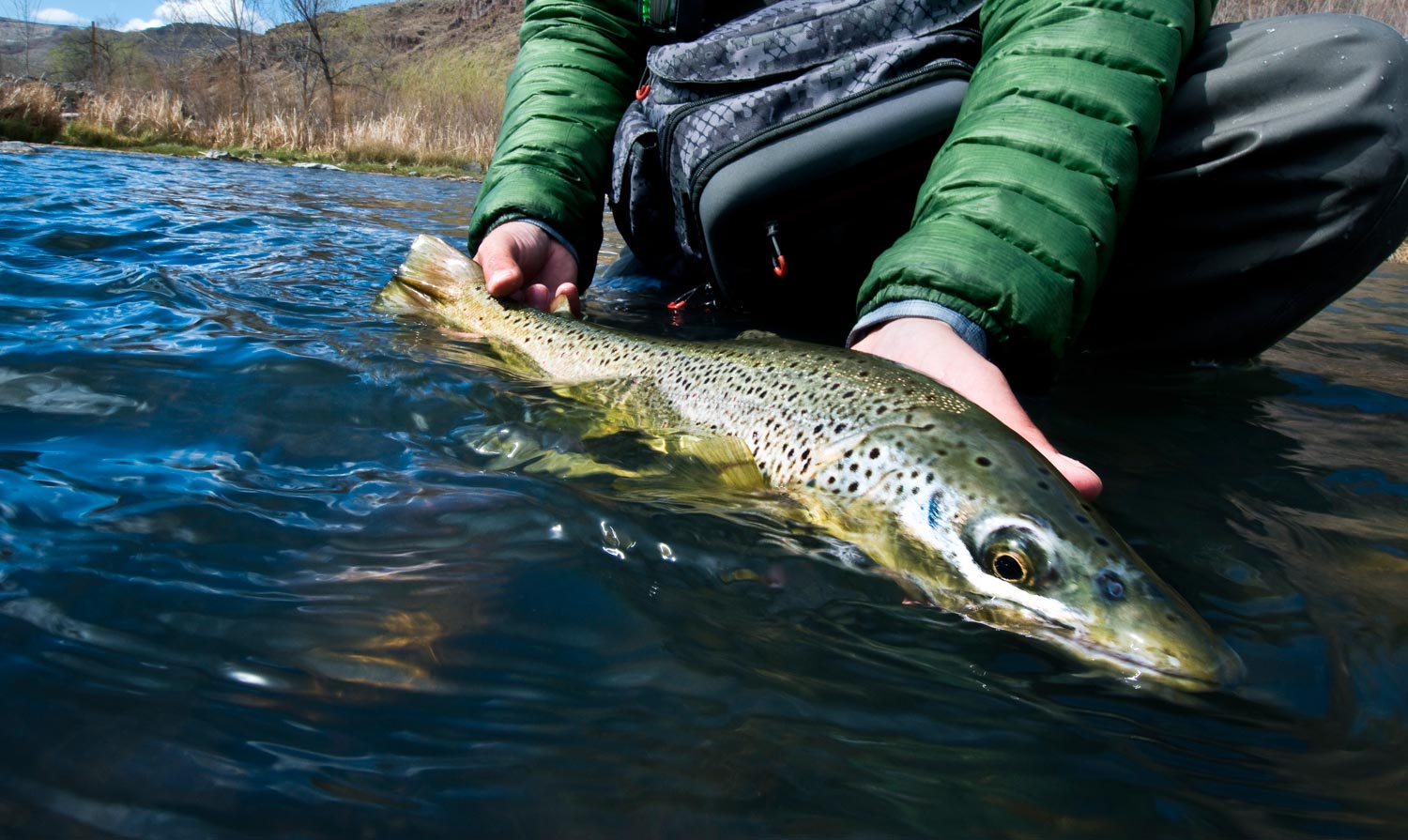
Most of you are aware that Louis and I just got back from fly fishing and filming our segment for Playground Earth, sponsored by BFGoodrich Tires. We had the pleasure of fly fishing the Owyhee River, one of the finest trophy brown trout tailwaters I’ve ever had the opportunity to wet a line. The resident brown trout here proved to be quite picky, calling for not only accurate drag-free presentations from us, but our casts also had to be timed correctly to the feeding trout we had located. Out of the thousands of flies that we had on hand between us, two nymph patterns accounted for 80% of all trout landed. The splitcase bwo nymph and the splitcase pmd nymph were regular taken for naturals on the water througout our time on the Owyhee River. Never again will I only have a handful of these patterns on hand. I was down to my last splitcase nymph by the end of the trip.
Read More »Saturday Shoutout / Legalize S.C.O.F.
Are you ready for some culture?
Southern Culture on the Fly is back with their winter edition. Tune in and turn on with some red fish, winter trout, water wolves, bunny masks and a hundred reasons you should be kicking plastic. Who knows, you might even finally understand the Pig Farm. But don’t count on it.
Get yourself some culture.
Read More »4 Ways To Catch More Tailwater Trout
By Kyle Wilkinson
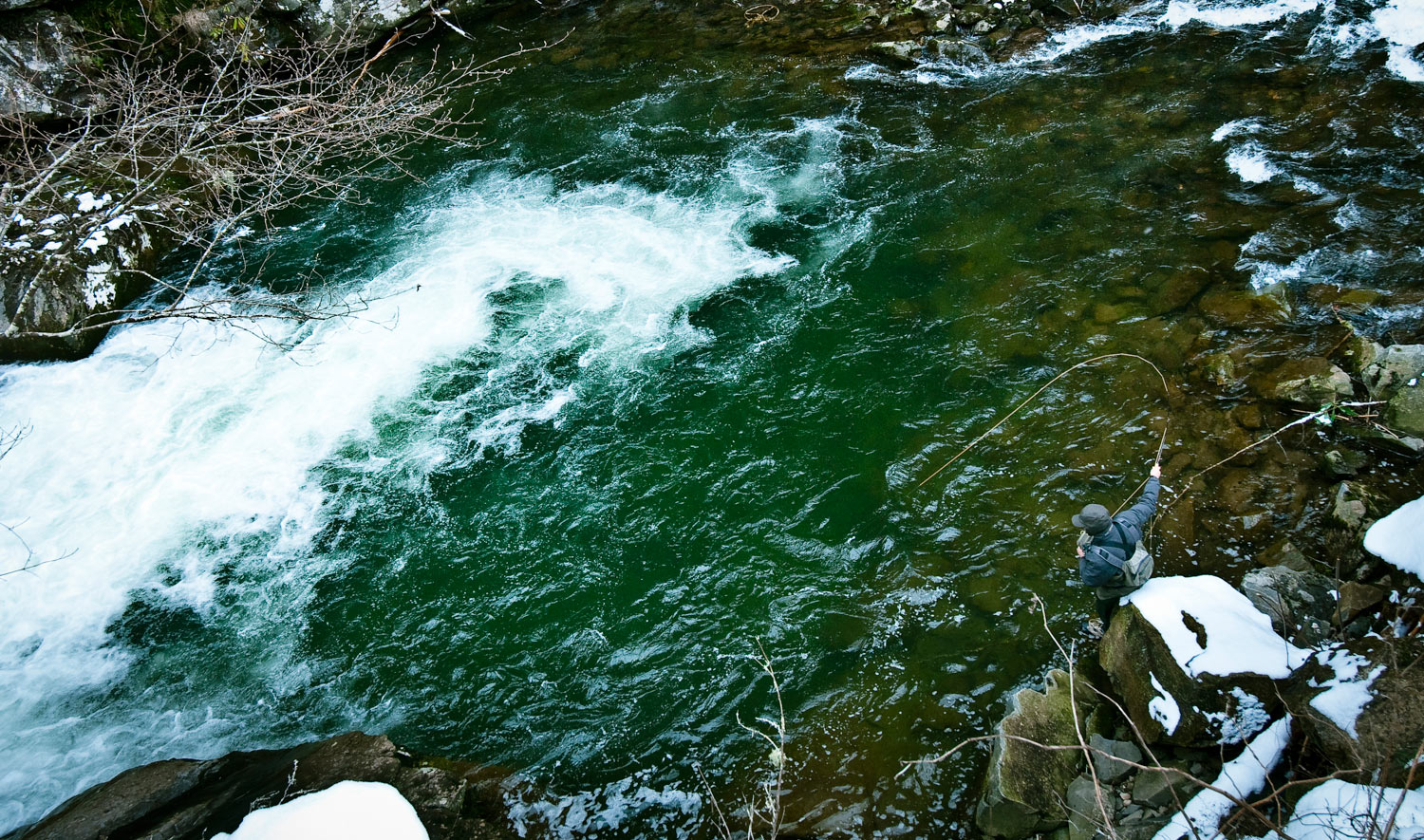
If the arrival of winter does not signal an end to your fishing, chances are good you’re going to be spending some time on a tailwater in the months to come.
While the issue of dams and rivers is clearly a topic for another day, the fact remains that dams have created some pretty incredible wintertime trout playgrounds for those willing to endure frozen fingers and guides. Aside from the fact that tailwater fisheries are known to grow incredibly large, in most places they are also known to grow incredibly intelligent trout. The reasons for this are two-fold. 1) The fish have a TON of natural food for them due to the consistent water temps and flows created by said dam. 2) Tailwaters typically receive quite a bit of angling pressure and as such, most of the trout swimming here are going to have a PhD in spotting a poor drift. Does this mean then that catching a tailwater trout or two should be a bonus, while heading home with a skunk on your back should be the norm? Absolutely not! Remember, big trout have to eat all the time to maintain their size and as such, are going to remain very catchable as long as we put the odds in our favor.
HERE ARE FOUR TIPS THAT I RELIGIOUSLY LIVE BY WHEN FISHING FOR TAILWATER TROUT. IF YOU DON’T ALREADY, PUT THESE TO USE NEXT TIME YOU HIT THE WATER AND I THINK YOU’LL BE PLEASANTLY DELIGHTED WITH THE RESULTS.
1. Tighten Up Flies. This is a big one for me and is something I promise will help put fish in the net. Do this: hold your hand out in front of you and make a fist. Now extend your thumb and pinky out in opposite directions. That distance between your two digits is the spacing to use for your flies. Depending on the size of your hands, you’re probably looking at 8-10” and this is perfect! I’m well aware this will seem very strange if you’re used to fishing your flies 18” apart (like I see people doing all the time out on the water) but I encourage you to give it a try. Remember, a tailwater trout -–particularly in the winter–is rarely going to chase down a meal. Giving that fish as many options as possible directly in front of their face is going to increase your chances of catching it dramatically!
Use Split Shot AND Putty. This is another non-negotiable for me on the technical tailwaters of Colorado. When rigging up in the morning, I’ll place one split shot 8-10” above my first fly– usually somewhere between a size 2-4. After this, I will use tungsten putty to make all my additional weight adjustments throughout the day. Using this type of putty couldn’t be easier and allows me to dial in my weight to a much greater degree than I could by pinching multiple split shots on and off my tippet throughout the day. When I come to a location that requires more weight, I’ll simply pinch off a bit of putty, flatten it between my thumb an index finger, and then roll directly on top of my split shot. Make a nice round ball and you’ll be good to go. If I realize the putty I added
Read More »Don’t Gink it, Sink It
By Kent Klewein
Ever been on a trout stream during a blanket hatch and no matter how many times you drift your floating imitation over the rising fish, it’s ignored?
I’ve experienced this frustrating situation many times on the water. When this happened in the past, I used to think I was using the wrong pattern, or I was getting micro-drag during my drift or maybe my tippet was too large. Although one or more of these can often be the culprit of failing to get bites during a heavy hatch, it’s actually more common that you’re problem lies in the fact that you’re choosing to fish your fly on the surface instead of below the surface.
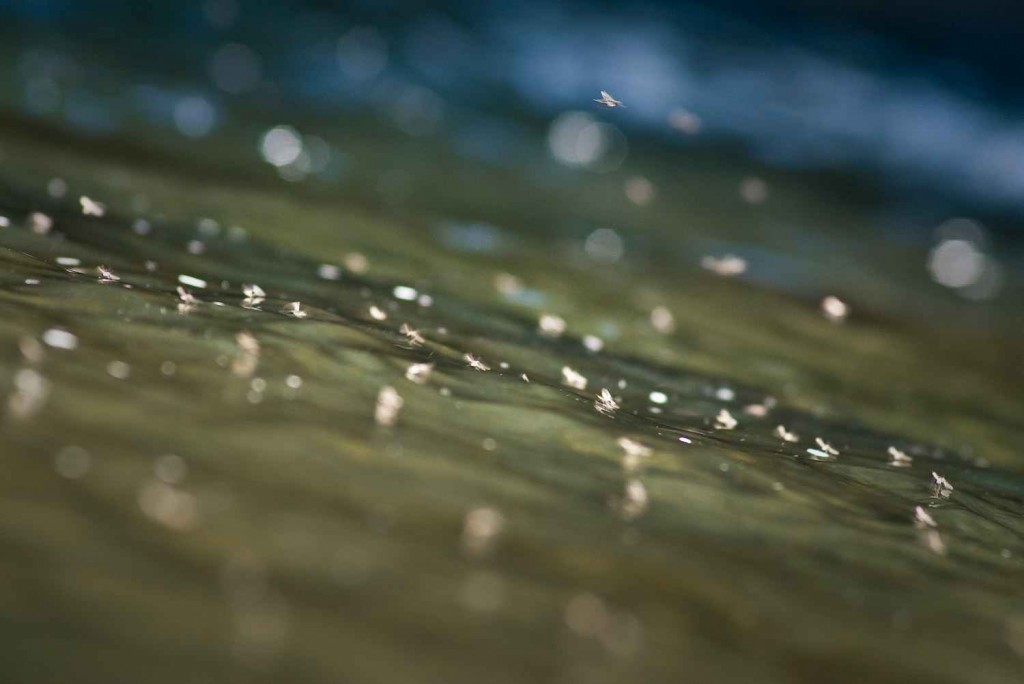
When hundreds or even thousands of bugs are on the water it makes your fly pattern very difficult to distinguish itself apart from all the other naturals on the water. Take for instance a trico spinner fall in late August or September. When in full swing, it can seem like almost every square inch of the water is covered with these tiny guys at times. Although many of them float long distances on the surface, eventually they will sink. Not all at once of course, just a portion of them here and there. When you choose to sink your fly pattern instead of floating it, you’re going to increase your chances of catching those feeding fish for three reasons.
1. You decrease the amount of competition between your fly and all the naturals.
By sinking your fly pattern below all the naturals on the surface your giving you’re pattern a much better chance of the fish spotting it. Below the surface there’s going to be far less naturals packed in close proximity to each other than on the surface.
2. The closer your fly is to the fish the easier it is for them to eat it.
By sinking your fly pattern, you’rr positioning your fly closer to the feeding fish. This gives you an advantage, because it makes
Reece’s Squirrely Dragon
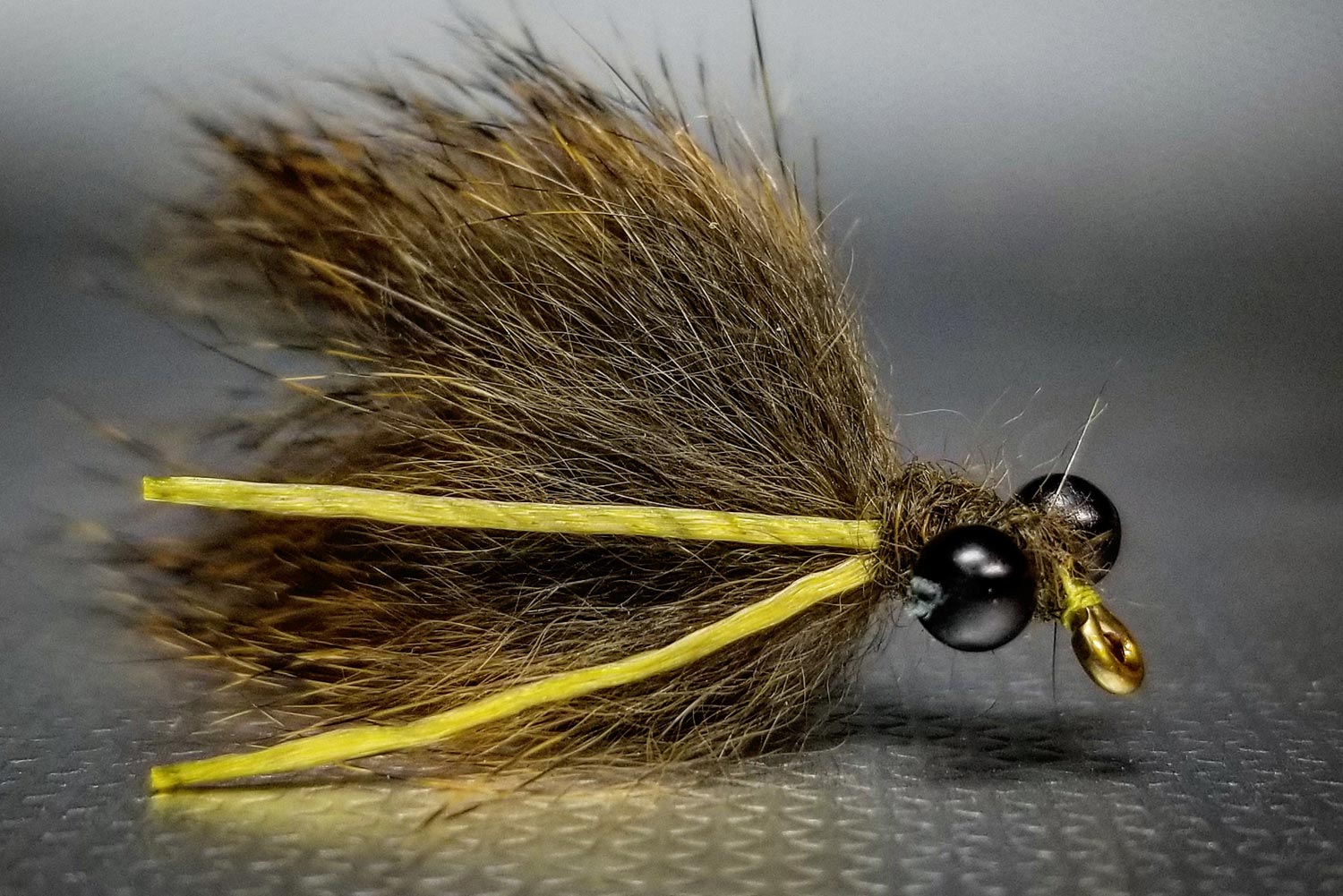
By Bob Reece
I’m a little OCD and a lot routine based.
As soon as the liquid water in my area of the country turns to a solid, I turn to the vise. The initial point of focus is to fill my still water boxes. My first step in that journey is to start cranking out my Squirrely Dragons.
Dragon fly nymphs are a key element in the food webs of the still waters that I typically fish. Their presence does not go unnoticed by the trout that call these places home. Nor should they go unnoticed by you if they are found in your local lakes and ponds.
The life cycle of these often significantly sized predators spans multiple years. As a result of this they are available to still water trout, in their nymph form, throughout the open water season. Their size and color varies greatly among species and bodies of water. Taking the time to turn over rocks, logs and floating vegetation will often produce specimens. This can provide invaluable information that can subsequently be used to create accurate imitations. In the lakes that I guide on, there are drastic variations in both body and eye coloration. By accurately matching these differences I’ve been able to increase the success of my clients.
The simplicity of this pattern lends itself to a quick creation. The zonkered pine squirrel body and dubbing provide the mottled coloration frequently seen in dragon fly nymphs. The pulsing underwater movement of this material mimics the contraction and expansion of the abdomen used by the natural to propel itself forward. Legs constructed of MFC Sexi Floss add realistic movement. Simultaneously, the plastic bead chain eyes imitate one of the most prominent traits seen in the naturals.
As we round the corner toward spring, follow the way of the dragon. These supersized members of still water food webs should take their place in your box. Adding Reece’s Squirrely Dragon to your arsenal will help you make the most of your on-the-water opportunities.
WATCH THESE TWO VIDEOS AND TIE REECE’S SQUIRRELY DRAGON.
Read More »Sunday Classic / Big Trouble in Little Mountain
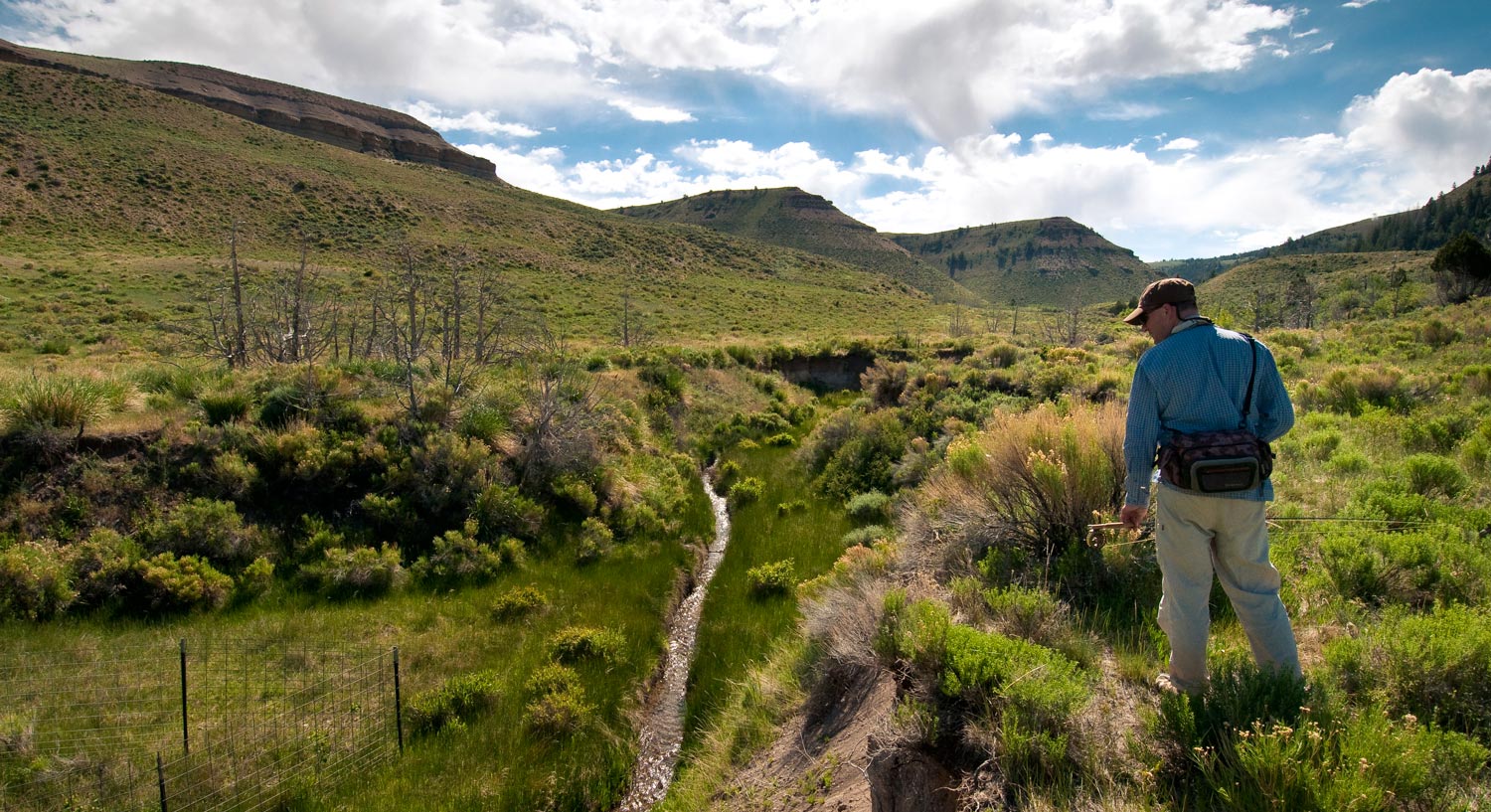
“I KNOW WHAT YOU’RE THINKING,” STEVE TELLS ME. “I CAME ALL THE WAY TO WYOMING FOR THIS?”
I look down from the deep head cut at the trickle of water below. It’s, maybe, eighteen inches wide and no more than six deep. The red earth stream bed is pounded flat by the desert sun and the flow is about what a bath tub faucet would produce. A good skipping stone would pass for structure. I can’t imagine how it could hold a trout. Steve is right.
“Give it a chance,” he tells me. His eyes sparkle and an eager smile spreads across his face. “At some point today, this little stream is going to surprise you.”
Red creek is one of a handful of tiny streams that drain Wyoming’s Little Mountain district. The area is better known by sportsmen for its remarkable elk hunting than its fishing. You don’t have to spend very long there to see why a Little Mountain elk tag is one of the most coveted in the west. We see several large bachelor groups on the drive in. They are poised, heads held high and moving light on their hooves, the sun on their velvet racks etching bright gold lines against the morning sky. There are mule deer, eagle, antelope and nesting hawks. The landscape is idyllic, vast, striking and uninhabited. Endless red hills covered with sage brush are slashed by lush green valleys dotted with wild flowers. It’s an oasis for the eyes in a state that can be rough as a cob.
Little Mountain is due east from the famous Flaming Gorge of the Green River. Anglers come from around the globe to float the Green below Flaming Gorge reservoir. The tail water is well known to hold huge trout, as does the reservoir. Rainbow, brown and cutthroat trout as well as carp and the invasive burbot. Lake trout, brook and tiger trout, kokanee salmon, small mouth bass, large mouth bass, catfish and white fish all inhabit the 3,789,000 acre-feet of Flaming Gorge Reservoir. It’s a manmade cacophony of nonnative species, never imagined in nature. Few of the anglers who fish it know that only a few miles east, the beautiful and fragile native Colorado River Cutthroat (CRC) is making its last stand.
Red Creek is known to hold one of the few genetically pure CRC populations in Wyoming. Years ago game and fish officials stocked most streams in the west with cutthroat trout. Their good intentions lead to disastrous results. The practice would go on for decades before scientists began to identify the myriad of sub-species that make up the cutthroat family. By the time this complicated diversity was understood, hybridization had muddled the genetics of cutthroat in most watersheds.
The CRC population in Red Creek was saved by an unlikely intervention. An improperly installed
Read More »Saturday Shoutout / Mr. White
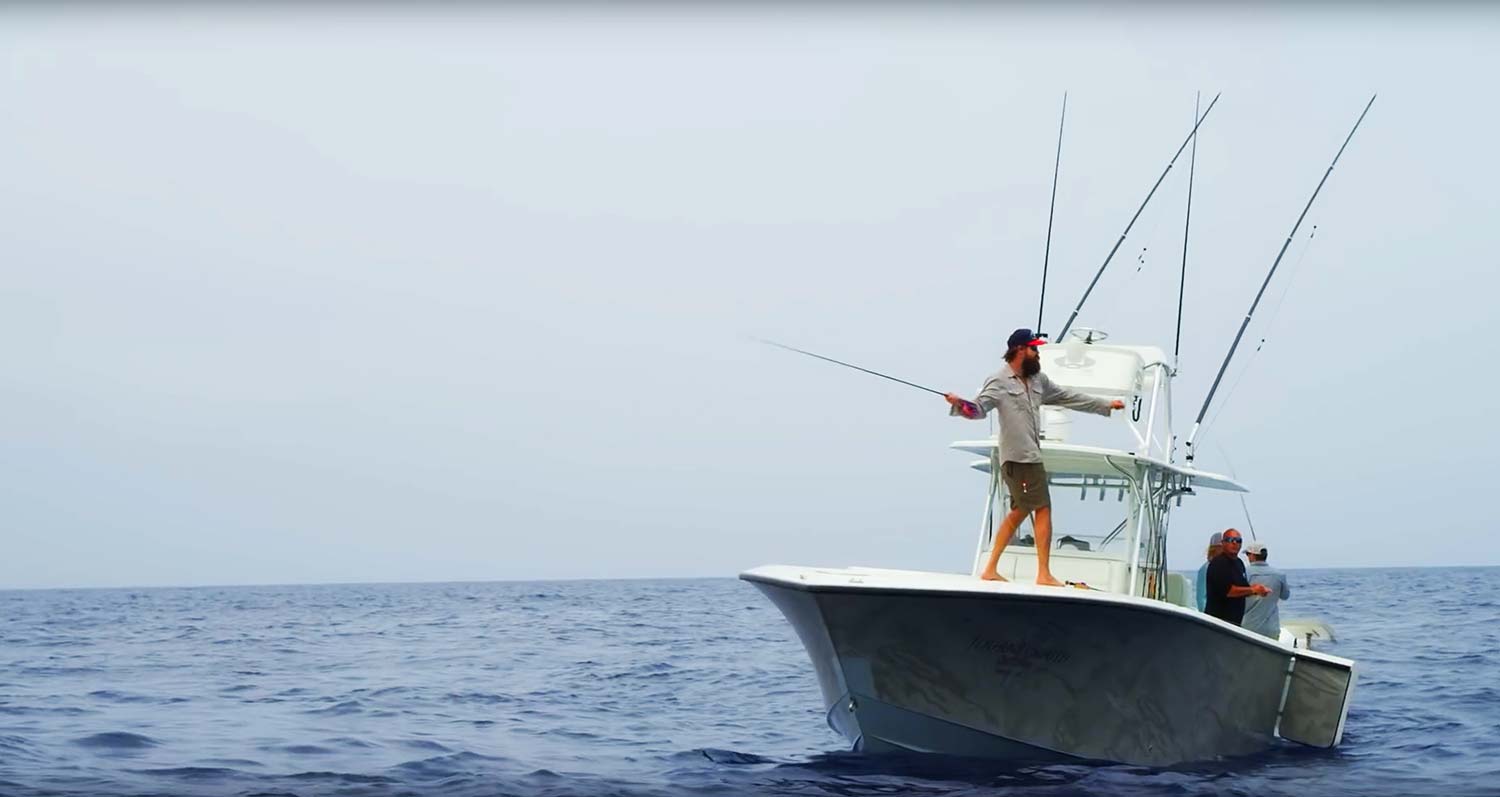
Only one person comes to mind, Oliver White.
I was talking with some anglers the other day about Lefty Kreh. Sadly, Lefty’s health as not been good recently. Although friends tell me he has rallied and is feeling pretty good at present, it has caused us all to picture a time without him. Someone brought up that it wouldn’t be long before we lost all of the legends of the sport.
“Who is going to take their place?” He wondered.
“Only one person comes to mind,” I replied.
I have known Oliver White for several years now. Only casually at first but I’m now happy to call him my friend and to host my Bonefish Schools at his lodges in the Bahamas. The more I get to know him, the more impressed I am. Oliver’s background is almost mythical in proportion. If you are not familiar with his story, it’s covered in one of the videos below. His career ark spans the globe, from Tierra del Fuego to Wall Street, and includes being both a hedge fund analyst and a hostage.
Although Oliver is a brilliant business man and a world class angler, neither is what really impresses me about him. It’s his character. Oliver always says what he thinks, a trait I always respect, but he does it in a way that heals rather than harms. His passion is infectious, especially when it comes to conservation. Through his work with Indy Fly, Oliver is not only saving fisheries but the indigenous people who call then home.
Below are a few excellent videos featuring Oliver White. Take a few minutes and get to know the fellow I think is the next legend of fly fishing.
Read More »Build Your Own Fly Rod: DIY Video 5
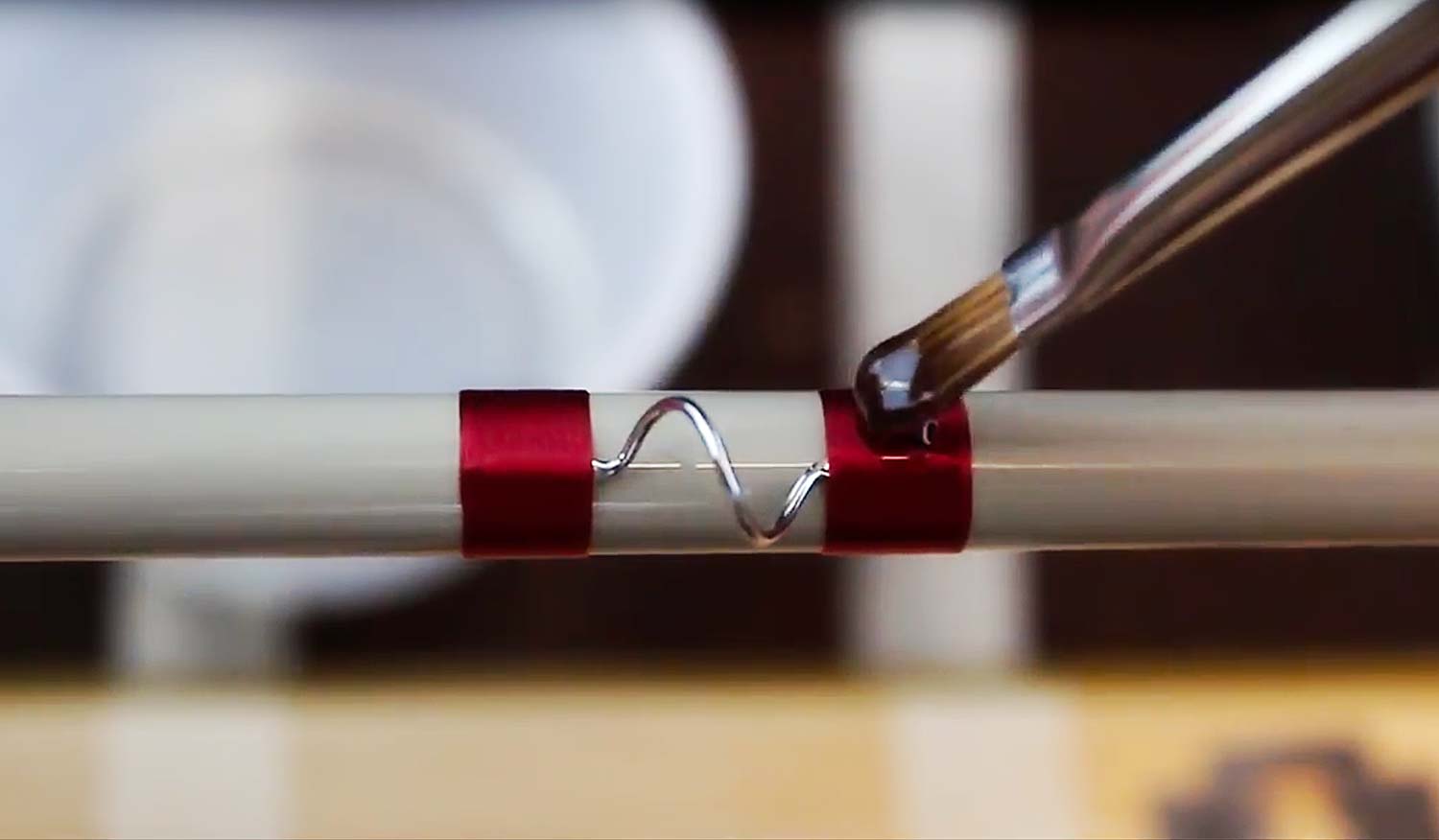
Matt Draft of Proof Fly Fishing is back for episode 5 of our DIY fly rod build.
In this episode Matt will go over the techniques for mixing thread finish for a perfect finish on your wraps. He’ll show you how to prep the wraps and apply the finish for a smooth coating with no bubbles and level the finish for wraps you can show off with pride. Just in case everything doesn’t go perfectly, Matt will cover troubleshooting some common finish problems.
Check out Matt’s site, Proof Fly Fishing. As a special thank you to G&G readers, Matt will be offering free shipping on all of his kits for the next seven weeks. Just use the code G&Gfreeship on his web site.
Build Your Own Fly Rod: DIY Video 5: Prepping wraps and applying thread finish.
Read More »The Klink Hopper
By Bob Reece
The world of fly patterns is well saturated with hopper patterns.
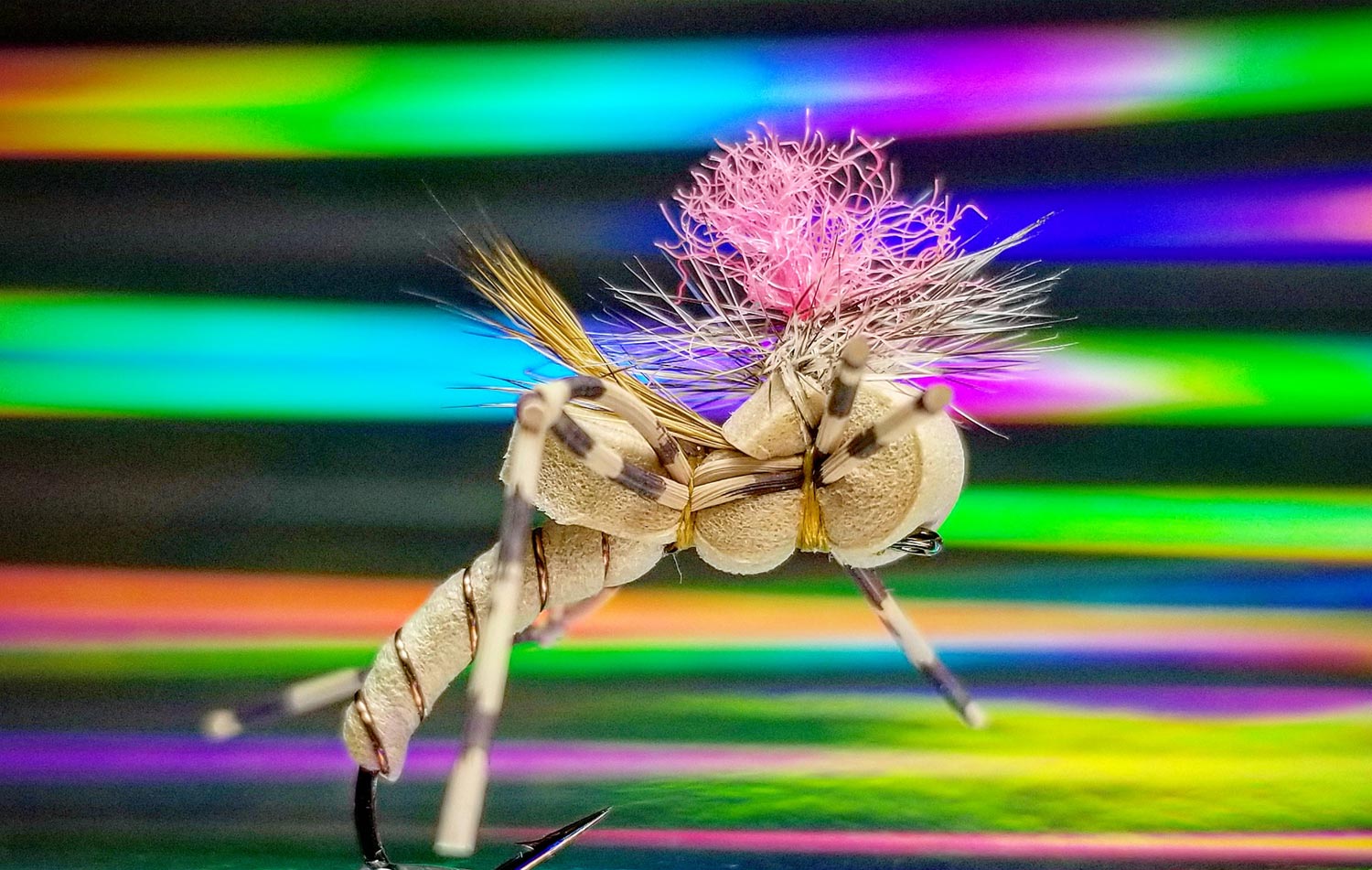
It’s rare to see something in this genre that separates itself from the masses. Colby Crossland’s Klink Hopper does just that.
Colby is a guide for the Spinner Fall guide service on Utah’s beloved Green River. He spends a large percentage of his year behind the oars, facilitating fly fishing with his clients. Terrestrial patterns are a key element in his arsenal during the summer and early fall months. Over the past year he set out to create a highly buoyant hopper with aesthetics that diverged from the norm. The result of this venture was the Klink Hopper.
The Klink Hopper’s buoyancy is second only to an indicator. In addition to this, its profile does a wonderful job of imitating a struggling hopper. It also conveys vulnerability. After all, not all hoppers float along until they are slashed from the surface by hungry trout. Many of these tasty terrestrials drown and descend to the stream bottom.
Stuck in the shuck emergers have changed the dry fly game. In the same way this pattern has the potential to change our terrestrial tactics. This transitional link between the surface and the depths will be available as an addition to your terrestrial box through Rainy’s in 2018.
Watch the video and learn to tie The Klink Hopper!
Read More »Sunday Classic / Spring Bass Tactics for Southern Appalachian Lakes
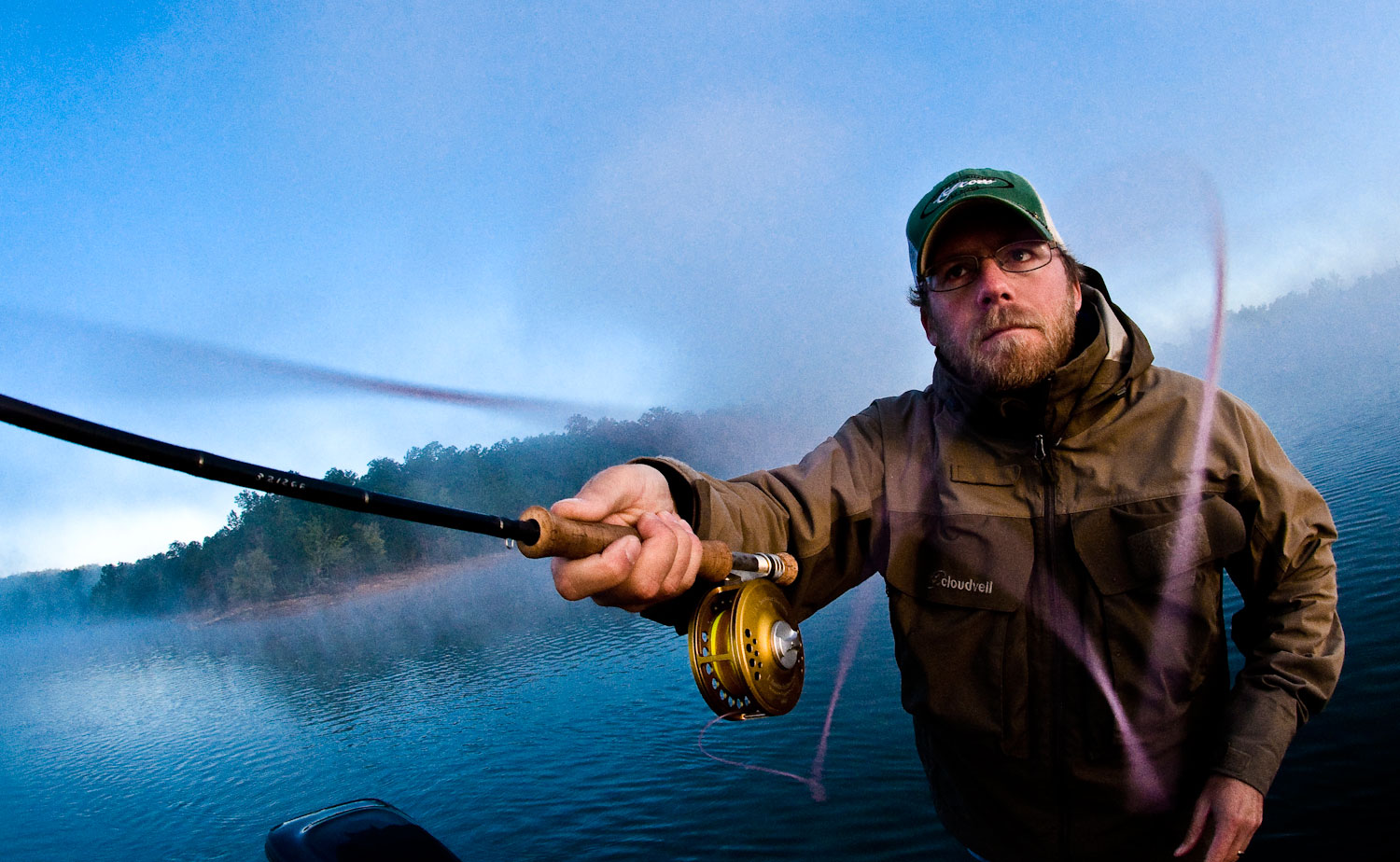
SPRING BASS FISHING TACTICS FOR FLY ANGLERS INTERESTED IN SOUTHERN APPALACHIAN RESERVOIRS.
There’s tons of lakes readily available for fly fisherman to catch bass throughout the Southern Appalachian region. Unfortunately, these lakes aren’t your two-acre farm pond in your backyard or subdivision that you grew up fishing as a kid—they’re multi-thousand acre reservoirs that can be extremely challenging to learn how to fly fish.
FLY FISHING RESERVOIRS STARTS WITH FISHING THE CORRECT AREAS.
Fly fishing for bass on public reservoirs is much like trying to find a needle in a haystack. If you don’t have a general idea of where the needle is located, your chances of finding it are slim to none. To be successful fly fishing lakes, you’ll have to quickly be able to eliminate areas of the lake where the bass aren’t located and then narrow your focus to small areas of the lake that provide bass what they need. Bass need the following: suitable habitat, satisfactory food and comfortable water conditions (water temperature & water depth). All these change depending on the season. In our case, we’ll be focusing on what bass need during the spring. Just like in trout fishing, bass fishing is all about bypassing unproductive water and spending your time fishing the productive water. Eighty percent of the bass on the lakes will be found in 20 percent of the water. If you want to catch them, you’ll need to maximize your time fly fishing the correct water.
A QUALITY MAP OF THE LAKE IS CRITICAL
Keep in mind, all maps aren’t created equal (and many are total crap). The map you want to buy
Read More »